
Field Sales Automation software: The Complete Guide for FMCG Brands in India (2026)
Your field sales team works hard every single day. They cover beats, visit retailers, take orders, and push your products. But here’s the question worth asking: are they working with the right tools to sell more — or just to report more?
Field sales automation software has a reputation problem. Many brands think of it as a tracking tool. A way to know where the sales rep is. A way to catch someone who isn’t working.
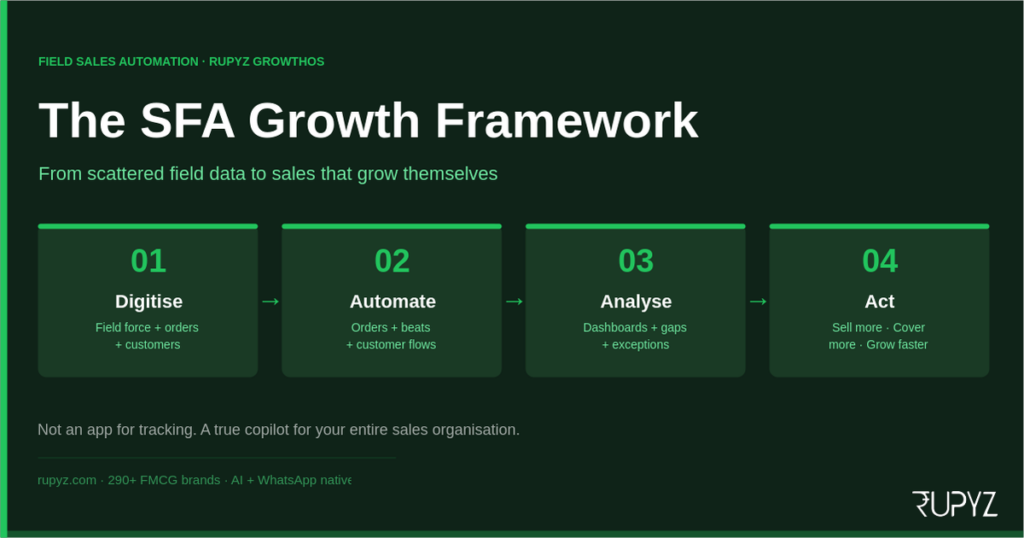
That framing is wrong. And expensive. Think of it this way. The real objective of field sales automation software is to digitise your entire sales operation — your field force, your customers, your orders, your distribution channel. Once you digitise, automation follows naturally: order automation, customer management, lead tracking, beat planning. Once you automate, data flows continuously into the system. And once you have clean, real-time data, the software becomes what it was always meant to be — a decision engine. The framework is simple: Digitise → Automate → Analyse → Act. Management gets visibility. Gaps and exceptions get surfaced automatically. The sales team gets the intelligence to sell more. And the brand gets the data to make faster, better decisions — not at month end, but today. One more thing worth stating upfront. Distribution in India is no longer just about General Trade. The dynamics are shifting fast. Brands today need to manage General Trade, Modern Trade, HoReCa, and eB2B (e-commerce) — all at once, often with the same field force and the same technology stack. A field sales automation software that only supports GT beats is already behind. The right software supports omni-channel distribution — so your field team can execute across every channel your brand operates in, from the kirana around the corner to the hotel chain in the next city. That is the real promise of field sales automation software. Not an app for tracking. A true copilot for your entire sales organisation.
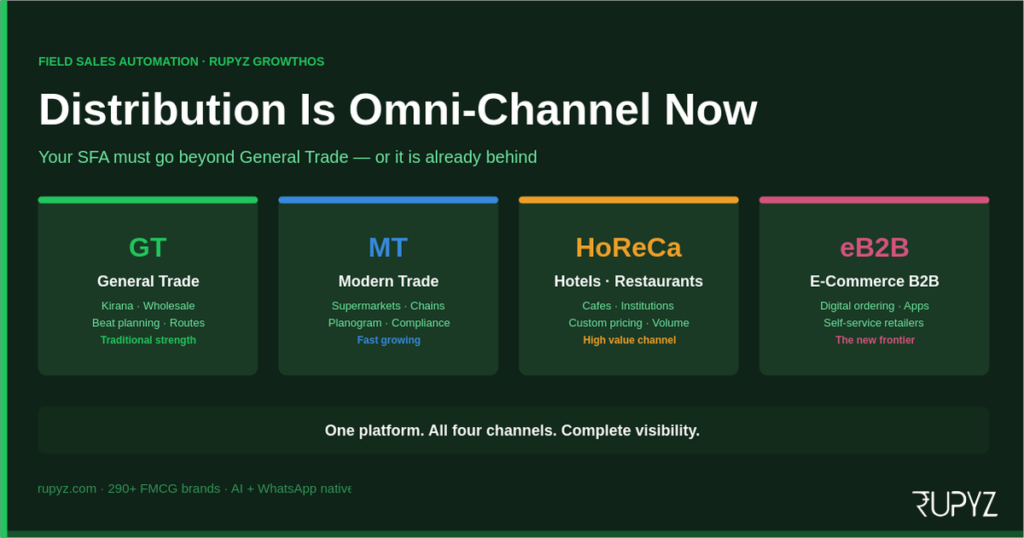
The best field sales automation software doesn’t just track your team — it equips them to sell more, cover more ground, and hit their targets consistently. Whether your team calls it field sales automation software , sales force automation, or simply SFA software — the goal is the same: more sales, better decisions, faster growth. It gives your NSM and ZSM real-time intelligence to coach and intervene. It gives your leadership a single source of truth to make faster, better decisions. And critically, it manages your entire channel — from primary sales at the brand level all the way to secondary and tertiary sales at the retailer.
This guide is for brand owners, NSMs, ZSMs, HR leaders, and startup founders evaluating field sales management software. We’ll cover when you need it, what to look for, and what separates sales force automation tools that drive growth from tools that just add administrative burden.
Is Field Sales Automation software About Tracking — Or Growth?
Let’s address the elephant in the room.
Yes, field sales automation software can track location. It can log check-ins. It can show you who is where on a map at any given time.
But that’s the floor, not the ceiling.
The real value is what it does for your sales rep’s ability to sell:
- Tells them which outlets have zero billing this month — so they prioritise the right visits.
- Suggests which SKUs to pitch at each outlet based on purchase history and outlet profile.
- Shows the shortest road route through their beat so they waste less time and cover more ground.
- Flags outlets with high reorder probability so the rep shows up before the retailer even calls.
- Alerts the manager mid-day when a rep is underperforming — enabling coaching, not postmortems.
- Captures not just orders but also no-order reasons, surveys, merchandising activities, and image proof — giving leadership the full picture of what’s happening at the outlet level.
- Delivers reports and dashboards so decisions are made on data, not intuition.
Progress, not policing. That’s the right frame for field sales automation software. The tracking is a byproduct — not the purpose.
Who Should Be Using Field Sales Automation Software?
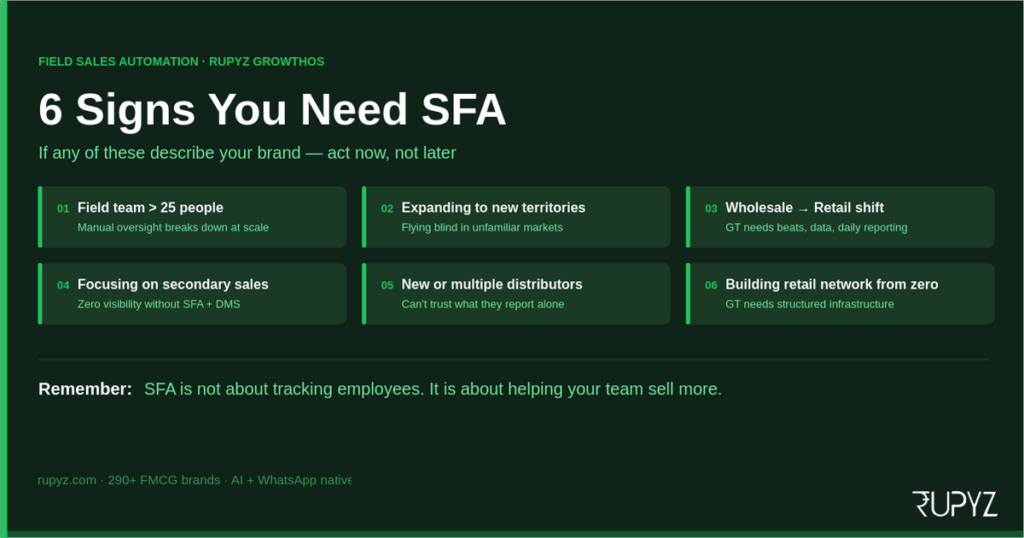
Not every business needs it on day one. But if any of the following describe your situation, field sales automation isn’t optional — it’s urgent.
1. Your field sales team has crossed 25 people
Below 25, you can manage with WhatsApp groups and Excel. Above 25, you have blind spots. You don’t know who is visiting which outlets, what’s being promised to retailers, or why collections are slipping. Manual oversight breaks down at scale.
2. You are expanding into new territories
New city. New distributor. New field reps who don’t know the market. Without a field sales CRM, you are flying blind. The software becomes your ground-level intelligence system — mapping outlets, tracking productivity, flagging gaps before they become losses.
3. You are shifting from wholesale to retail / brand-direct selling
This shift requires beat planning, outlet-level data, and daily sales reporting — things that field sales automation software makes possible at scale. Without it, you’re managing this transition on WhatsApp and hope.
4. You are serious about secondary and tertiary sales
If your brand cares about what actually moves off the retailer’s shelf, you need visibility into secondary sales — and eventually tertiary sales too. See the dedicated section below on full channel management.
5. Your distributor is new or you have multiple distributors in a territory
A new distributor doesn’t have your brand’s interests at heart yet. Field sales automation software gives you direct visibility into their outlet coverage, order frequency, and billing patterns — so you don’t rely entirely on what they report.
6. You are building a retail network from scratch
For startups and challenger brands entering general trade: India’s retail landscape is vast and fragmented. A GT-first go-to-market without field sales automation software is like mapping a city with paper and pen. The software gives you the infrastructure to build systematically.
Primary, Secondary, and Tertiary Sales: Why Your SFA Must Cover the Full Channel
This is one of the most underappreciated requirements when brands evaluate field sales management software. Most tools manage only one or two layers of the channel. The right platform manages all three.
Primary Sales — Brand to Distributor
This is the brand’s order to the distributor: stock dispatched, invoice raised, payment terms set. Your ERP or accounting system typically captures this. The question is whether your field sales platform is connected to it in real time.
When it isn’t, the field rep takes a secondary order without knowing the distributor is already out of stock. The order gets cancelled. The retailer is disappointed. The rep’s credibility suffers.
Secondary Sales — Distributor to Retailer
This is where most field sales activity happens. The rep visits the retailer, takes the order, the distributor fulfils it. Secondary sales data is the most important layer for a brand — it tells you what is actually moving in the market, which outlets are buying, and where your competitors are gaining ground.
Yet this is precisely where most brands have zero real-time visibility. They find out what happened in secondary sales at the end of the month from distributor reports — which are often incomplete, delayed, and unverifiable.
Tertiary Sales — Retailer to End Consumer
Tertiary sales are harder to capture but increasingly important, especially for brands running promotional schemes, loyalty programs, or targeted consumer activations. Some platforms now allow brands to capture tertiary movement data through retailer-level stock audits, offtake surveys, and AI-powered outlet analytics.
What this means for your software evaluation: ask whether the platform gives you a single, connected view of all three layers. Primary orders syncing from your ERP. Secondary orders captured by the field rep in real time. Tertiary visibility through stock audits and survey data. If any layer is disconnected, your distribution data will always have gaps.
Rupyz GrowthOS is one of the few platforms in India built to manage this full channel — with SFA, DMS, OMS, and B2B ordering working as a unified system. Learn more about field sales management for FMCG brands.
The Complete Evaluation Checklist: 19 Points to Assess Any sales force automation software or Field Sales Automation software
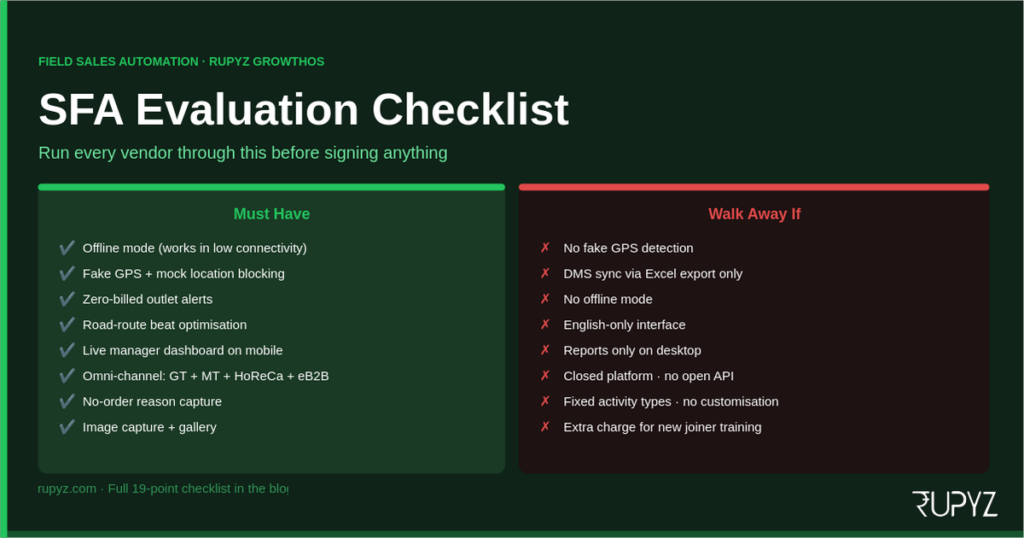
Not all field sales automation software is equal. Before you sign any contract or start a pilot, run the vendor through all 19 of these criteria.
- Does the app motivate sales reps to sell more — or just report more?
Look for: target visibility, daily performance scores, achievement tracking. If the app only shows tasks and check-ins, it’s a reporting tool, not a growth tool.
- Can you manage and cascade targets from the top down?
NSM sets national targets. ZSM gets state targets. ASM gets district targets. Field rep gets outlet-level targets. If this can’t be done in the software, it will stay on Excel.
- Does the app show beat potential and outlet potential to the field rep?
The rep should see reorder probability, days since last bill, and estimated outlet revenue potential. This turns a rep from an order-taker into a salesperson.
- Does it identify zero-billed and missed outlets automatically?
The software should surface these automatically — not wait for the manager to spot the gap in a spreadsheet at month end.
- Does it optimise beat routes and regenerate footmaps on the fly?
Road-route optimisation (not aerial distance) saves 30–60 minutes per rep per day. The ability to regenerate a footmap when an outlet is closed is a meaningful productivity multiplier.
- Does it work on both Android and iOS?
Most field force apps are Android-first. If your ASM or NSM uses an iPhone and can’t access the manager dashboard on their device, you have an adoption problem from day one.
- Is after-sales support strong — and is recurring training included at no extra cost?
Field teams have 30–40% annual attrition. Every new joiner needs training. If the vendor charges per session, your actual cost of ownership is much higher than the sticker price. Get this in writing.
- Does the app block fake GPS, mock location, developer mode, and VPN spoofing?
This is non-negotiable. Fake GPS spoofing is widespread in India. Genuine field sales tracking software must detect and block this at the device level — not just flag it in a report later.
- Is the UI simple enough that a field rep in Tier 3 can use it on day one?
Complex interfaces kill adoption. If the rep needs 30 minutes of training every time a new feature is added, the app will be quietly abandoned in the field.
- Does it work fully offline?
Large parts of India have unreliable mobile data. Orders, check-ins, and data entry must work offline and sync when connectivity returns. No exceptions.
- Does the app suggest outlet potential and recommend SKUs to pitch?
AI-powered basket suggestion at the outlet level directly increases average order value. The rep should know what to pitch before walking through the door.
- Does geofencing work smoothly without draining the phone battery?
Geofencing verifies that a rep is at the outlet during check-in. But poorly implemented geofencing drains battery and causes crashes. Test this rigorously in the pilot phase.
- Can the app capture no-order reasons, surveys, merchandising, and custom activities?
When a rep visits an outlet and doesn’t take an order, the reason matters. Was the retailer overstocked? Was a competitor running a better scheme? Was it a reach problem? If the app doesn’t capture no-order reasons and other field activities, you are losing critical market intelligence every single day. See the dedicated section below.
- Does the app support image capture, image gallery, and image recognition?
Photo evidence is one of the most powerful tools in field execution. See the dedicated section below.
- Can the sales rep see live scheme and offer information in the app?
Field reps often don’t know which schemes are currently running. The app should surface active schemes, eligibility, and expiry dates in real time — so the rep uses schemes as a sales tool, not discovers them from the retailer.
- Can the sales rep capture stock audit, inventory data, and travel expenses in the app?
Field reps should do everything in one place. Splitting stock audit into a separate tool or managing TA/DA in Excel creates friction and reduces data completeness.
- How strong are the reporting, dashboards, and analytical capabilities? — Critical
Live dashboards on mobile, exception alerts, custom KPIs by role, AI-generated summaries, automated WhatsApp/email reports. See the dedicated section below.
- Does the SFA integrate deeply with your DMS, ERP, and other systems — via open APIs? — Critical
Open APIs are essential. The platform should integrate with your existing tech stack: SAP, Oracle, Tally, QuickBooks, WhatsApp, and more. See the dedicated section below.
- Are activities in the app fully customisable for your brand’s specific workflow?
Every brand has unique field activities. A platform with rigid, fixed activity types will force your team to work around the software instead of with it. See the dedicated section below.
Beyond Orders: No-Order Reasons, Surveys, Merchandising, and Custom Activities
Most brands evaluate field sales automation software by looking at one thing: the order-taking workflow. But orders are only part of what a field rep does in a day.
In reality, a significant percentage of outlet visits don’t result in an order. The retailer is overstocked. A competitor just gave a better deal. There is a billing dispute. The outlet owner isn’t available. Each of these is actionable intelligence — if it’s captured.
No-Order Reason Capture
When a rep visits an outlet and leaves without an order, the app should prompt them to record the reason. Over time, patterns in no-order reasons reveal systemic issues:
- High “overstocked” reason in a territory — suggests the rep is pushing too hard on volume without matching outlet demand.
- High “competitor scheme” reason in a region — signals a competitive threat that leadership needs to respond to quickly.
- High “owner not available” reason for a specific rep — may indicate they’re visiting at the wrong time or not planning beats efficiently.
Without no-order reason capture, all you know is the order didn’t happen. With it, you know why — and you can act.
Surveys and Market Intelligence
The field rep is your brand’s eyes and ears at the outlet level. A good field sales CRM lets you push surveys to the field force and capture structured market intelligence:
- Scheme feedback — is the scheme being communicated? Is the retailer aware of it?
- New product launch tracking — is the product on the shelf? Is it visible? Is the retailer stocking it?
- Competitor intelligence — which brands are running trade promotions in this territory right now?
- Retailer satisfaction surveys — feedback that can identify churn risk before it becomes a lost outlet.
Merchandising Activity Capture
For brands with in-store activation or merchandising requirements — shelf visibility, display standards, POP material placement — the field rep should be able to record these activities against each outlet visit. Not in a separate app. Not on a paper form. In the same SFA they use for everything else.
Fully Customisable Activities: Why This Matters
Every FMCG brand has unique field activities. A spice brand needs outlet cooking demonstrations logged. A personal care brand needs sampling data captured. A beverage brand needs cooler health checks recorded.
A rigid activity template built by a software vendor will never perfectly match your brand’s field workflow. This is why fully customisable activities are a non-negotiable feature for serious FMCG brands.
In Rupyz, activities are fully customisable at the brand level. You define what activities your field team should complete at each outlet type, in each beat, for each campaign. The app enforces the workflow. The dashboard tracks completion. You get consistent data from every rep in every territory — without manual follow-up.
Image Capture, Image Gallery, and Image Recognition: The Proof Layer of Field Sales automation software
In field sales, seeing is believing. A rep can report that a product is on the shelf. A rep can report that a display is set up. A rep can report that a retailer visit happened. But without image evidence, brand leadership has no way to verify any of it.
Image capture is not a nice-to-have feature. It is the verification layer that makes the rest of your field data trustworthy.
What Image Capture Enables
- Outlet visit verification — Rep captures a photo at the outlet during check-in. GPS coordinates and timestamp are embedded automatically. No way to fake the visit.
- Shelf health capture — Rep photographs the shelf, showing your brand’s products, competitor products, and any gaps in the planogram.
- Display and POP compliance — Rep captures the display stand, branding material, or cooler placement. Management can review remotely without a physical visit.
- New outlet onboarding — Rep captures a photo of the outlet facade, signage, and interior. This image is attached to the outlet record permanently for future reference.
- Damage and defect reporting — Rep photographs damaged goods or malfunctioning coolers. The issue is logged instantly and routed to the right team.
Image Gallery: A Unique and Underrated Feature
Beyond individual image capture, a centralised image gallery at the outlet level is a feature very few SFA platforms offer — and one that Rupyz has built as a core capability.
The image gallery gives brand managers and ASMs a chronological visual history of every outlet. You can see how shelf space has changed over 12 months. You can see whether the display that was installed in Q1 is still up in Q3. You can identify outlets where your brand’s visibility is declining before the sales data tells you.
In India’s fragmented retail environment, where brand execution varies dramatically from outlet to outlet and street to street, this visual intelligence is genuinely powerful.
Image Recognition and AI Analysis
The next frontier in field sales execution is image recognition — where AI analyses the photos your field reps capture and automatically extracts structured data from them:
- How many facings does your brand have on the shelf?
- Are your products placed at eye level or on the bottom shelf?
- Which competitor brands are present and what is their shelf share?
- Is the planogram being followed? Which SKUs are missing?
This moves image capture from a compliance verification tool to a market intelligence tool — giving brands data on retail execution at scale without requiring manual review of thousands of photos.
The Data Problem No One Talks About: Garbage In, Garbage Out
The software is only as good as the data in it.
If your outlet database has fake outlets, duplicates, outlets with invalid mobile numbers, or outlets geo-tagged at incorrect locations — your beat plans will be wrong, your coverage reports will lie, and your dashboards will mislead you. The same applies to every field activity, no-order reason, and survey response that enters the system.
| Common data quality issues to check for: |
| • Outlets with the same mobile number (duplicates) |
| • Outlets tagged at headquarters or the distributor’s address (lazy data entry) |
| • Outlets marked as active that closed 18 months ago |
| • Outlets with no GPS geo-tag |
| • Fake outlets created by reps to inflate outlet count numbers |
| • No-order reasons entered as ‘other’ to avoid accountability |
Look for software that proactively prevents bad data from entering the system:
- Blocks outlet creation if the mobile number already exists.
- Rejects outlets created at the same GPS coordinates as an existing outlet.
- Requires mandatory photo capture at check-in.
- Blocks entry from devices running fake GPS, developer mode, or VPN.
- Enforces structured activity capture — no open-text workarounds.
Across brands using AI-verified outlet data, over 1 lakh fake or duplicate outlets have been identified and removed. The downstream effect on beat planning accuracy, dashboard reliability, and target setting is significant.
Reports, Dashboards, and Analytics: The Real Reason Brands Invest in SFA
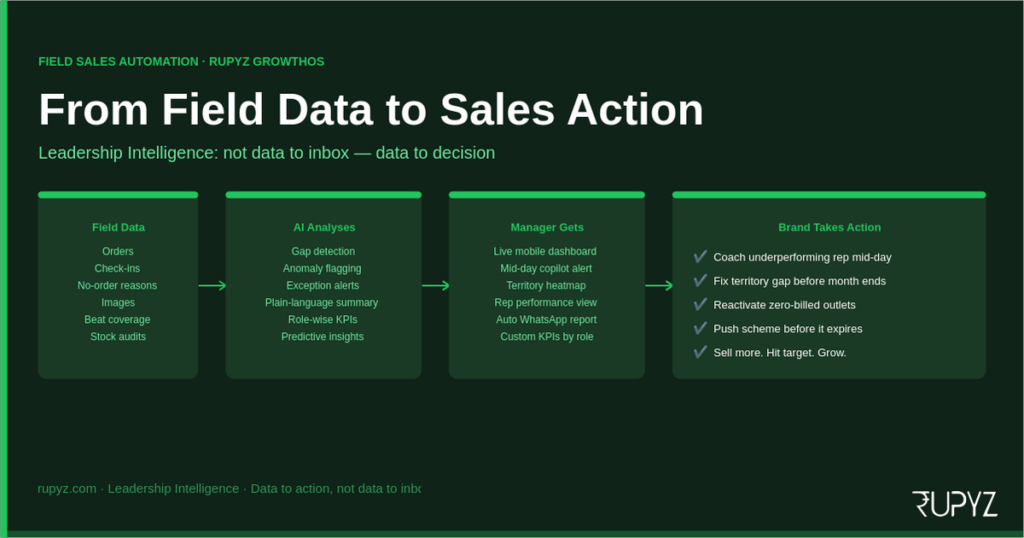
Honest truth: the reason brands invest in field sales automation software is not the tracking. It’s the data.
At the end of every day, week, and month, a brand needs to answer real questions:
- Which territories are underperforming and why?
- Which reps are consistently missing their beat coverage targets?
- Which outlets haven’t billed in 45 days and need intervention?
- Where are no-order reasons clustering — and what is the common cause?
- Are my schemes being communicated effectively by the field force?
- What is my actual coverage vs. planned coverage in each city?
Without strong reports and dashboards, you can’t answer these questions reliably. You’re making decisions based on WhatsApp messages, verbal updates in the morning call, and gut feel.
Most SFA tools generate reports. But the reports require someone to pull them, analyse them, and forward them. By the time the NSM sees the data, the opportunity to act is gone.
What Good Reporting Looks Like
- Live mobile dashboards — The NSM opens their phone at 11am and sees exactly how today is tracking against target. Not a PDF. A live dashboard.
- Exception alerts, not just summaries — The system alerts: ‘Territory X is at 40% of today’s target at 2pm.’ This enables real-time coaching, not end-of-day postmortem.
- Custom KPIs by role — CEO sees revenue and coverage. NSM sees territory-wise achievement vs. target. ZSM sees rep-level productivity. The right platform configures dashboards per role without a separate BI tool.
- AI-generated summaries — Complex data transformed into plain-language insights. Instead of staring at tables, leadership gets: ‘3 territories are at risk of missing monthly targets.’
- Scheduled reports on WhatsApp and email — Morning summary. Evening coverage report. Weekly territory review. These land automatically at configured times — no manual effort required.
- Anomaly detection and gap flagging — When a territory that normally bills ₹12L in the first week is at ₹4L by Day 8, the system flags it without anyone asking.
- From insight to action — Detect a gap, generate an insight, send a notification, create a task, track resolution. The report is not the end. The resolution is.
Rupyz Leadership Intelligence
Rupyz’s Leadership Intelligence module delivers: custom dashboards configurable by role, AI auto-updated reporting, anomaly detection, AI-generated plain-language summaries, automated delivery via WhatsApp and email, and mid-day manager copilot alerts. Data to action — not data to inbox.
Open APIs and Integration: Why a Closed Platform Is a Dead End
No software does everything. Every brand has an existing tech stack — an ERP, an accounting system, a WhatsApp tool, a loyalty platform, an e-commerce system. The field sales automation software you choose must connect to all of it.
This is why open APIs are non-negotiable.
What Open APIs Enable
- ERP sync — SAP, Oracle, Microsoft Dynamics 365. Primary orders, pricing, credit limits, and scheme data sync in real time. No duplicate data entry. No reconciliation lag.
- Accounting software sync — Tally, QuickBooks. Orders placed in the field generate invoices automatically in the accounting system.
- WhatsApp and messaging platforms — Order confirmations, scheme announcements, and delivery alerts go to retailers via WhatsApp automatically, triggered by events in the SFA.
- B2B e-commerce and retailer ordering portals — Secondary ordering isn’t only through the field rep. Retailers who prefer to self-order should be able to do so through a connected B2B app, with the same product catalogue, pricing, and scheme data.
- Loyalty and consumer apps — Brands running retailer loyalty programs need the SFA to feed purchase data into the loyalty platform in real time.
- Third-party analytics and BI tools — For brands with existing BI investments, open APIs allow SFA data to feed into Power BI, Tableau, or any other analytics platform.
The Risk of Closed Platforms
Some SFA vendors operate as closed ecosystems. You can’t integrate with your ERP without paying for a custom project. You can’t push data to your analytics tool. You can’t connect your B2B ordering app. Every integration is a negotiation.
Over time, a closed platform becomes a data silo. Your field sales data is trapped inside the vendor’s system, disconnected from the rest of your business. When you eventually want to switch, your historical data is held hostage.
Ask any vendor you evaluate: ‘What is your API documentation? What data can we read and write via API? Are webhooks available?’ The answer will tell you immediately whether this is a platform built for enterprise distribution or a tool built for vendor lock-in.
Rupyz operates on an open API architecture with REST APIs and webhooks, real-time sync with SAP, Oracle, Dynamics 365, Tally, and QuickBooks, and native integrations with WhatsApp, Google Maps, Facebook, Instagram, and Justdial.
Fully Customisable Activities: Your Business, Your Workflow
Every FMCG brand has a unique field execution model. A beverage brand’s field day looks different from a spice brand’s. A personal care brand’s outlet activities are different from a building materials brand’s.
Yet most field sales automation software ships with a fixed set of activity types: check-in, order, check-out. Sometimes a stock audit. Sometimes an expense entry. And that’s it.
If your brand has activities that don’t fit the vendor’s template, you’re forced to work around the software. This kills adoption and degrades data quality.
What Customisable Activities Look Like in Practice
- A beverage brand configures a cooler health check activity — with a mandatory photo, a condition rating, and a service request trigger if the cooler needs repair.
- A personal care brand configures a sampling activity — capturing how many units were sampled at each outlet and the retailer’s feedback.
- A snacks brand configures a visibility audit activity — recording which SKUs are visible, which are on the top shelf, and whether the brand’s POSM is in place.
- A pharma brand configures a doctor call activity — different from a retailer visit, with different data fields, mandatory capture requirements, and reporting logic.
In Rupyz, activities are fully customisable at the brand level. You define what the field team should do at each outlet type, in each beat, for each campaign. The app enforces it. The dashboard tracks it. You get consistent execution data from every rep in every territory.
This is the difference between software that adapts to your business and software that asks your business to adapt to it.
The Adoption Problem: Why Most SFA Implementations Fail
Most SFA implementations fail not because the software is bad, but because the field team doesn’t use it. Adoption failure happens for three predictable reasons:
- The app is too complex.
If a rep needs to navigate seven screens to log a single visit, they won’t. They’ll get frustrated and go back to WhatsApp.
- The app is perceived as surveillance, not support.
If management’s first use of the data is to catch someone who clocked out early, the rep’s relationship with the app is adversarial from day one. Growth-first positioning changes this — show reps how the app helps them hit targets and earn incentives.
- Training happens at launch and never again.
Field teams have 30–40% annual attrition. New joiners who never received proper training use the app poorly and degrade data quality for everyone.
When evaluating any field sales tracking software, ask: how do you handle onboarding for new joiners six months from now? Is it included? Is there regional language support?
India’s field force speaks Hindi, Gujarati, Marathi, Tamil, Telugu, Kannada, and many other languages. A field sales app that only works in English will have lower adoption in Tier 2 and Tier 3 markets — often where the biggest growth opportunity is.
A Note on Rupyz GrowthOS: Built for FMCG, Built for Growth
As you evaluate your options, Rupyz field sales management software for FMCG is worth a close look. Rupyz is trusted by 290+ food and FMCG brands across India — personal care, home care, snacks, beverages, spices, agri-inputs, pharma, and building materials.
- Full channel management — SFA, DMS, and OMS working as a unified system. Primary, secondary, and tertiary sales in one platform. Not three separate tools with an Excel bridge between them.
- AI-native architecture — Intelligence built into the core: outlet scoring, basket suggestion, anomaly detection, manager copilot alerts.
- WhatsApp-native — Every retailer gets order confirmation on WhatsApp. Schemes, new launches, and surveys go via WhatsApp. One dedicated Meta-certified FMCG specialist per brand.
- Agentic AI calling — AI calls retailers in Hindi and 50+ Indian languages for order taking, queries, surveys, and outlet verification. Covers unattended outlets at 80% lower cost than a field visit.
- Fully customisable activities — No-order reason capture, surveys, merchandising, and any activity type your brand needs. Configured to your workflow, not the vendor’s template.
- Image capture, image gallery, and image recognition — GPS-tagged photo evidence at every outlet. Centralised image gallery with full outlet visual history. AI-powered image recognition for shelf analysis and execution compliance.
- Leadership Intelligence Dashboard — Custom KPIs by role. AI auto-updated dashboards. Anomaly detection. AI-generated summaries. Automated delivery via WhatsApp and email.
- Manager copilot notifications — Mid-day alerts on underperformance. Managers coach before the day ends, not after.
- 12-language support in-app — Drives adoption where English-only apps struggle.
- Fake GPS, mock location, developer mode, and VPN blocking — Triple-layer location integrity. Data you can trust means dashboards you can trust.
- Open API architecture — REST APIs and webhooks. Real-time sync with SAP, Oracle, Dynamics 365, Tally, QuickBooks. Native integrations with WhatsApp, Google Maps, Facebook, Instagram, Justdial.
- Rupyz Pay — embedded channel financing — Zero-recourse supply chain finance. Brand gets paid upfront. Distributor repays from sales. Net positive for distributor ordering capacity. Zero credit risk for the brand.
- Offline-first Android app — Road-route TA/DA calculation. Works without connectivity. Built for India’s real field conditions.
Rupyz is positioned as a growth operating system, not a tracking tool. The name GrowthOS says it directly.
Complete Evaluation Checklist: Summary
| MUST HAVE — Non-negotiable features: |
| ✔ Offline mode that works in low-connectivity areas |
| ✔ Fake GPS / mock location / developer mode / VPN blocking |
| ✔ Zero-billed outlet and missed outlet alerts |
| ✔ Beat planning with road-route optimisation |
| ✔ Android + iOS support |
| ✔ No-order reason capture |
| ✔ Omni-channel coverage: GT, Modern Trade, HoReCa, and eB2B |
| ✔ DMS integration (real-time, not batch) |
| ✔ Manager dashboard with live MIS on mobile |
| ✔ Image capture with GPS tag and timestamp |
| ✔ Live scheme visibility for field rep |
| GROWTH DIFFERENTIATORS — What separates good from great: |
| ✔ AI-powered outlet potential scoring and basket suggestion |
| ✔ Manager copilot alerts for real-time mid-day coaching |
| ✔ Multi-language support (Hindi + regional languages) |
| ✔ WhatsApp integration for retailer communication |
| ✔ In-app stock audit and TA/DA expense capture |
| ✔ Customisable activities for surveys, merchandising, and brand-specific workflows |
| ✔ Image gallery with outlet visual history |
| ✔ Image recognition / AI shelf analysis |
| ✔ AI-generated reports, dashboards, and anomaly detection |
| ✔ Scheduled report delivery via WhatsApp and email |
| ✔ Open API with REST + webhooks |
| ✔ ERP / Tally integration (real-time sync) |
| ✔ Channel financing integration |
| ✔ Recurring training support at no additional cost |
| RED FLAGS — Walk away if: |
| ✗ No fake GPS detection |
| ✗ No no-order reason capture |
| ✗ DMS or ERP integration requires manual Excel sync |
| ✗ No offline mode |
| ✗ English-only interface |
| ✗ Fixed activity types with no customisation |
| ✗ No image capture or image gallery |
| ✗ Reports only on desktop (no mobile dashboard) |
| ✗ Manager must pull reports manually — no automated alerts |
| ✗ Closed platform: no open API or webhook support |
| ✗ Extra cost for training new joiners |
Conclusion: The Software You Choose Shapes the Business You Build
Field sales automation software is not a cost. It is infrastructure.
The right SFA platform gives your field rep intelligence to sell smarter. It gives your manager visibility to lead proactively. It captures the full picture of what happens in the field — orders, no-order reasons, surveys, images, activities — so leadership can act on real data, not assumptions. It manages your channel from primary to secondary to tertiary, across General Trade, Modern Trade, HoReCa, and eB2B — with every layer connected in real time.
The wrong platform gives you a map of check-ins, a team that resents the app, and reports that no one reads. Choose field sales management software that is built for growth, not just compliance.
The question to ask any vendor: is this software designed to help my team sell more and my leadership decide faster — or just to document what happened?
Choose software that answers: sell more. Decide faster. Grow.
| Ready to Transform Your Field Sales? See how 290+ FMCG brands are closing more sales, covering more outlets, and growing faster with Rupyz GrowthOS. Book a Free Demo at rupyz.com | Call: +91 70246 44044 |