
You spent months evaluating software. Negotiated the contract. Ran the training. Launched with full enthusiasm.
Six months later, your field reps are still sending orders on WhatsApp. The SFA app sits on their phone, barely opened. Your dashboard shows 30% daily active usage at best. The data coming in is incomplete, inconsistent, and frankly — not trustworthy.
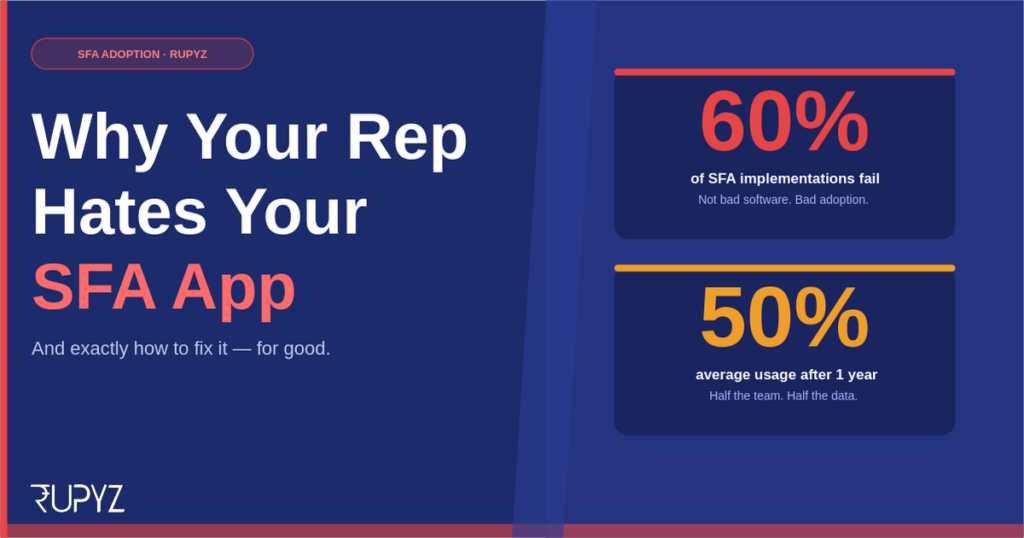
Sound familiar? You are not alone. Industry data shows that 60% of SFA implementations fail — and the failure has nothing to do with the software features. It has everything to do with adoption so why your field sales staff hates your SFA app
This is the problem no SFA vendor talks about in their sales pitch. They show you dashboards and demo flows. They don’t show you what happens three months after go-live when your rep in Tier 3 Rajasthan has quietly gone back to his paper notepad.
This blog is about why that happens — and what you can do about it. If you’re evaluating SFA software, read the complete field sales automation guide first. If you already have SFA deployed and adoption is the problem, this one is for you.
The Adoption Problem Is Bigger Than You Think
Let’s start with an uncomfortable number.
60%. That is the failure rate of SFA implementations globally. And failure here doesn’t mean the software crashed. It means the organisation didn’t get the value they paid for — because the team didn’t use it.
In India, the problem is even more acute. Here’s why:
- Field teams in India operate in some of the most challenging conditions in the world — variable connectivity, extreme heat, 30+ outlet visits per day, language barriers, and often limited digital literacy.
- Attrition in field sales roles runs at 30–40% annually in many FMCG categories. That means every year, a third of your team is new — and likely untrained on the app.
- Most SFA platforms are designed by engineers, not by field reps. The workflows reflect how a developer thinks a rep should work — not how a rep actually works when they’re standing outside a kirana in 40°C heat with 15 more outlets to cover.
The result: partial usage. Reps use the check-in feature because they have to. They skip the no-order reasons, the stock audit, the survey. The data that makes it into your dashboard is the minimum required to avoid a manager call — not the full picture you paid for.
5 Real Reasons – why your field sales staff hates your SFA app
Ask a field rep why they don’t use the SFA app fully, and they’ll rarely say it directly. They’ll say “network problem” or “battery issue.” What they actually mean is one of these five things:
1. The App Feels Like a Spy, Not a Helper
This is the most common and most damaging perception. When the first thing management does with SFA data is ask “why were you at this outlet for only 4 minutes?” — the rep’s relationship with the app is poisoned permanently.
The rep now sees the app as a surveillance tool. Something that gets them in trouble, not something that helps them. Every data point they enter is a potential weapon that management can use against them.
The fix is not a feature — it’s a philosophy. The app must be positioned, from day one, as something that helps the rep sell more and earn more. Not something that tracks them. The first conversations management has using SFA data should be about coaching, not catching.
2. It Takes Too Long to Do Simple Things
Time is a field rep’s scarcest resource. If logging a visit takes 3 minutes instead of 30 seconds, they will find a workaround. They’ll batch-enter visits at the end of the day from the auto. They’ll copy-paste yesterday’s data. They’ll enter approximate GPS locations.
We’ve seen apps where a rep has to fill 11 mandatory fields just to log a “no-order” visit. Eleven fields. For an outlet where the owner wasn’t even present.
The rule of thumb: if a core action (check-in, order, check-out) takes more than 60 seconds, adoption will suffer. If it takes more than 3 minutes, adoption will collapse.
3. The sales force automation App Doesn’t Work in Their World
Your field rep in rural Maharashtra doesn’t have 4G. Your rep in a basement wholesale market in Delhi has zero signal. Your rep in Kerala uses Malayalam — not English, not even Hindi.
An app that requires constant internet connectivity will fail in most of India’s real field conditions. An app that only works in English will have low adoption in every state outside of metro cities. An app that drains battery in 4 hours will be switched off by noon.
These are not edge cases. These are the normal working conditions of the majority of India’s field sales workforce.
4. It Doesn’t Help Them Do Their Job Better
Here is the honest question every field rep asks, consciously or unconsciously: “what does this app give me?”
If the answer is “nothing — it just makes me do more work so the manager can see a report” — the rep will use it minimally. They’ll do what’s required and nothing more.
But if the app tells them which outlets haven’t ordered in 30 days, suggests what to pitch at each outlet, shows them the shortest route through their beat, and alerts them to a scheme they can use to close a deal — then the app is genuinely useful. The rep’s targets become more achievable with the app than without it.
That’s the difference between a tracking tool and a growth tool. One the rep tolerates. The other the rep depends on.
5. They Got Trained Once and Never Again
Most SFA rollouts follow the same pattern: big launch, intensive training week, then nothing. Three months later, new joiners are learning the app from colleagues who half-know it themselves. Features that were demonstrated in training are forgotten. Workarounds become standard practice.
Field team attrition means your SFA training is a recurring cost, not a one-time event. If your vendor charges extra for every training session, you’ll skip them. And adoption will slowly erode.
3 Management Mistakes That Kill Adoption Before It Starts
Adoption failure isn’t always the rep’s fault. Management makes predictable mistakes that undermine the entire implementation:
Mistake 1 — Launching without a clear ‘what’s in it for me’ for the rep
If you can’t answer the question “how does this app help the rep achieve their target and earn their incentive?” — you’re not ready to launch. The rep needs a concrete, personal reason to change their behaviour. “Management wants better data” is not that reason.
Mistake 2 — Using data to punish before using it to coach
The first 90 days of SFA data will be imperfect. Reps will game the system in small ways. They’ll check in from outside the outlet, enter round numbers for quantities, skip fields they find annoying.
If management’s first response is disciplinary action, the trust is broken permanently. The first 90 days should be about coaching — using the data to have better conversations, not to build a case against someone.
Mistake 3 — Choosing a platform without involving the field team
The people who evaluate SFA software are usually the NSM, the CTO, and the vendor. The people who use it every day — the field reps and ASMs — are rarely consulted. Then everyone is surprised when the reps don’t like the interface.
Run a pilot with 10–15 reps before full rollout. Their feedback will reveal friction points that no demo ever shows.
The Language Problem: The Most Underestimated Adoption Killer in India
India has 22 official languages and hundreds of dialects. A field rep in Tamil Nadu thinks in Tamil. A rep in Gujarat thinks in Gujarati. A rep in Uttar Pradesh thinks in Hindi.
Most SFA apps in India work only in English. Some have added Hindi. Very few support regional languages.
The result: a field rep using an app in a language they’re not comfortable in will always use it reluctantly. They’ll enter minimum information. They’ll skip fields they don’t understand. The data quality from non-English markets will always lag.
This is not a minor UX problem. It is a structural adoption barrier that affects the majority of India’s field sales workforce — the reps working in Tier 2, Tier 3, and rural markets where the biggest growth opportunity actually lies.
An app that supports 12 Indian languages isn’t a nice feature. In the Indian FMCG context, it’s a prerequisite for serious adoption.
The Positioning Fix: Growth Tool vs Tracking Tool
Everything about adoption comes down to one thing: how the rep perceives the app.
If they see it as a tracking tool: they’ll use it minimally, enter data carelessly, and find workarounds.
If they see it as a growth tool: they’ll use it proactively, trust the data it shows them, and depend on it to hit their targets.
The difference is not in the features — it’s in the positioning, and in what the app actually does for the rep.
| What a growth-positioned sales force automation app does for the field rep: |
| → Shows them which outlets are most likely to order today — so they prioritise smartly |
| → Suggests the right SKUs to pitch at each outlet — so they increase order value |
| → Gives them the shortest route through their beat — so they cover more ground |
| → Shows them their target vs. achievement in real time — so they know where they stand |
| → Alerts them to active schemes they can use to close deals — so they sell more |
| → Helps them capture everything in one app — so they don’t carry paper |
When the rep’s daily experience is “this app helps me do my job better and earn more” — adoption is no longer a problem you need to enforce. It becomes natural.
What Good SFA Adoption Looks Like — And How to Get There
Brands that achieve 80%+ SFA adoption consistently do five things differently:
1. They choose software built for the rep, not for the dashboard
The manager’s dashboard is the output. The rep’s mobile experience is the input. If the input experience is painful, the output will be garbage. Evaluate SFA software by handing it to a field rep and watching them use it — not by watching a vendor demo.
2. They position it as a growth tool from day one
The launch communication matters enormously. “We are tracking you” and “This app will help you hit your targets and earn more” will produce completely different adoption outcomes. The message sets the relationship.
3. They make recurring training non-negotiable — and free
Training at launch plus quarterly refreshers plus on-demand support for new joiners. This is table stakes. If your SFA vendor charges extra for training, factor that into your total cost of ownership. A platform that’s 20% cheaper but has a paid training model will cost more over three years.
4. They use data for coaching first, discipline later
For the first 90 days, use SFA data exclusively for coaching conversations. “I see you’re visiting 18 outlets a day on average — what’s preventing you from hitting 25?” is a very different conversation from “Why were you only at the outlet for 3 minutes?” One builds trust. The other destroys it.
5. They run a pilot before full rollout
Deploy with 15–20 reps across two territories. Give them 6 weeks. Collect feedback every week. Fix the friction points. Then roll out. This approach adds 6 weeks to your timeline and saves you 6 months of failed adoption. It also gives you internal champions — reps who know the app well and can train their peers. For a full evaluation framework, see the 19-point SFA checklist.
Why Rupyz Is Built Around Adoption, Not Just Features
Most SFA platforms are built around features. Rupyz is built around a different question: will the rep actually use this?
- — so reps in Tamil Nadu, Gujarat, Maharashtra, and Uttar Pradesh all use the app in their preferred language. This single feature has more impact on adoption in Tier 2 and Tier 3 markets than any other.12-language support
- — the first thing a rep sees when they open Rupyz is their target progress, their beat potential, and which outlets to prioritise today. Not a clock-in button.Designed as a growth tool, not a tracking tool
- — works without internet. Syncs when connectivity returns. A rep in rural Maharashtra with no 4G loses nothing.Offline-first
- — the app tells the rep what to sell at each outlet before they walk in. This directly increases their order value and their incentive earnings. The rep has a personal reason to use the feature.AI basket suggestion
- — managers get mid-day alerts on team productivity so they can make coaching calls before the day is lost. The rep experiences this as support, not monitoring.Manager copilot — not manager surveillance
- — reps can see their performance ranking, their target vs. achievement, and their progress toward incentives in real time. Motivation built into the workflow.Gamification and achievement visibility
- — new joiners get onboarded properly. Adoption doesn’t erode as the team turns over.Recurring training in 12 languages at no extra cost
The outcome: brands using Rupyz consistently report higher app usage rates than previous platforms — because the rep’s daily experience answers the question “what’s in it for me?” before they even have to ask it.
Conclusion: Adoption Is a Design Problem, Not a Discipline Problem
If your field sales rep hates your SFA app, the problem is almost never the rep.
It is a design problem — the app wasn’t designed for their real working conditions. It is a positioning problem — the app was sold to them as a tracking tool, not a growth tool. It is a training problem — they were onboarded once and left to figure the rest out themselves.
And occasionally, it is a software problem — the platform simply wasn’t built for India’s field realities.
The fix starts before you buy. Choose software that a field rep in Tier 3, working in 40°C heat with patchy connectivity, will actually want to open. Then position it right, train continuously, and use the data for coaching before you use it for accountability.
Do all of that, and adoption takes care of itself. For the complete framework on evaluating and buying field sales automation software, read the Field Sales Automation Complete Guide for FMCG Brands India (2026).
| See Field Sales Automation That Reps Actually Use Rupyz is built as a growth tool, not a tracking tool. 12-language support. AI-powered. 290+ FMCG brands trust it. Book a Free Demo at rupyz.com | Call: +91 70246 44044 |