
Outlet universe expansion is the fastest way FMCG brands in India discover hidden revenue. What if your sales team has been working hard every single day — and still missing thousands of potential customers in the very cities they operate in?
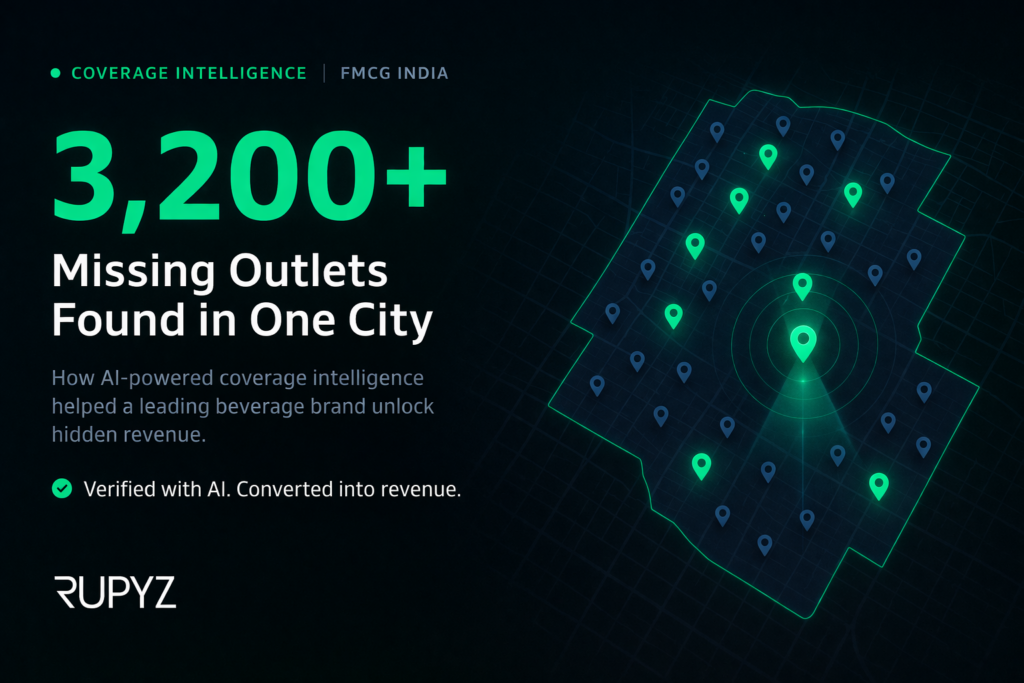
That’s exactly what happened to a leading beverage brand in India. Despite having an active field force covering their territory, a routine coverage intelligence audit revealed something startling: 3,200 outlets in a single city were completely missing from their distribution map.
These weren’t new outlets. They existed. Retailers were selling competing brands. And your sales team had never visited them — not because they were lazy, but because those outlets simply weren’t in the system.
This is the hidden cost of relying on manually-entered outlet data. And it’s a problem that affects virtually every FMCG, CPG, and consumer goods brand operating in India today.
The Problem: Your Outlet Universe Is Incomplete
Most FMCG brands in India operate with an outlet database that was built manually — field reps adding outlets one by one, distributor lists uploaded periodically, or data migrated from an older system years ago.
The result? A distribution map that feels complete but is riddled with gaps.
There are three types of missing outlets that drain revenue silently:
1. Outlets that never made it into the system Street-side kirana stores, newer outlets that opened after the last data refresh, or outlets in lanes that field reps historically skipped. These outlets exist and are active — they just don’t appear in your SFA.
2. Outlets that exist in public data but not in your database Google Maps, Justdial, Facebook Business listings, and Instagram business accounts contain millions of verified outlet records across India. Most brands have never cross-referenced their SFA data against these sources.
3. Outlets marked as closed or inactive but actually operating Field reps mark outlets as “closed” during visits. Some stay closed. Many reopen. Without verification, your database retains the wrong status — and those outlets never get visited again.
How Coverage Intelligence Works: 21+ Public Data Sources
Modern AI-powered distribution platforms like Rupyz address this gap through what’s called outlet universe expansion — a systematic process of discovering, verifying, and activating outlets your current database is missing.
The process draws from 21+ public data APIs simultaneously:
- Google Earth Pro — satellite-level geographic mapping of commercial areas
- Google Street View — visual verification of outlet existence at street level
- Google Maps — business listings with category, operating hours, and contact data
- Facebook & Instagram — business pages that indicate active retail presence
- Justdial — India’s largest local business directory with deep kirana coverage
- 16+ additional data sources — covering hyperlocal directories, telecom tower data, and community-contributed business listings
Note: All data sourced from publicly available APIs in compliance with respective platform terms of service.
This multi-source approach is critical because no single data source is complete. A kirana store may be on Justdial but not Google Maps. A new outlet may have an Instagram page but no formal listing anywhere. Cross-referencing 21+ sources dramatically increases discovery coverage.
The Beverage Brand Story: 3,200 Outlets in One City
When a leading beverage brand ran their first coverage intelligence audit using Rupyz, the scale of the gap was unexpected.
The numbers:
- City: One major metro in India
- Existing outlets in SFA database: ~8,000
- Missing outlets discovered through universe expansion: 3,200+
- That’s nearly 40% more outlets than they knew existed
The discovery process took days, not months. Each discovered outlet came with:
- Verified GPS coordinates (not approximate — sub-meter accuracy)
- Street View confirmation of outlet existence and type
- Outlet category and estimated potential grade
- Suggested beat plan integration
The sales team didn’t need to manually verify each outlet. The AI had already done the ground-level validation using Street View and multi-source cross-referencing.
What happened next?
The brand’s field force was reorganised to cover the newly discovered outlets over the following quarter. Within that period:
- Coverage expanded by 20-30% in the city
- New retailer relationships were established that competitors had been servicing exclusively
- Revenue from the city grew as previously untapped outlets began placing first orders
Why Manual Outlet Data Will Always Have Gaps
It’s worth understanding why this problem exists structurally — because it’s not a failure of the sales team. It’s a failure of the data collection method.
The manual entry problem: When a field rep visits 25-30 outlets a day, they enter data for outlets they know and visit. New outlets discovered on the street may get added. Many don’t — especially if the rep is rushing between beats.
The distributor list problem: Many brands rely on distributor-provided outlet lists as the master database. But distributors have an incentive to maintain control over their retailer relationships. Outlets they don’t actively service may simply not appear on their list.
The static data problem: Outlet data collected 2-3 years ago reflects the market as it existed then. India’s retail landscape — particularly in Tier 2 and Tier 3 cities — changes rapidly. New outlets open constantly. The database doesn’t update automatically.
The fake outlet problem: On the flip side, 1 lakh+ fake or duplicate outlets have been identified and eliminated across brands using AI-verified data. Outlets that exist on paper but not in reality inflate your coverage numbers while consuming planning resources.
The Business Case: What Does One Missing Outlet Cost?
Consider a conservative example:
- Average monthly order value per outlet: ₹5,000
- Missing outlets discovered: 3,200
- Even if only 30% place orders: 960 new billing outlets
- Monthly revenue addition: ₹48,00,000 (₹48 Lakhs)
- Annual revenue addition: ₹5.76 Crore
From a single city. From outlets that already existed and were already buying — just from a competitor.
This is why coverage intelligence is increasingly considered a revenue function, not just a data hygiene exercise.
Beyond Discovery: Verification, Grading, and Beat Planning
Finding missing outlets is step one. The real value comes from what happens next.
Outlet Grading Not every discovered outlet has equal potential. AI-powered grading scores each outlet by estimated revenue potential, income demographics of the surrounding area, and category fit for your products. Your field force focuses on high-potential outlets first.
Beat Plan Integration Discovered outlets are automatically slotted into optimised beat plans using road-route logic (Shortest Google map two wheeler route and not the aerial distance). Field staff receive updated routes that include new outlets without disrupting existing coverage.
WhatsApp-Powered Activation New outlets can be activated through WhatsApp outreach before a field visit — introducing the brand, sharing product catalogues, and capturing initial interest. This reduces the cold-call conversion time significantly.
Validation Speed With WhatsApp integration, outlet validation that previously took weeks through in-person visits can be completed 10X faster. A field team covering 30 outlets a day can validate 300 through a combination of AI verification and WhatsApp confirmation.
The Coverage Intelligence Checklist for FMCG Brand Managers
If you’re a distribution or sales manager at an FMCG brand, here are five questions worth asking:
- When was your outlet database last comprehensively audited? If the answer is “never” or “more than 12 months ago,” you almost certainly have significant gaps.
- How were your outlets originally entered into your SFA? If the answer is “manually by field reps” or “migrated from an older system,” data quality issues are likely.
- Do you know what percentage of your SFA outlets have been GPS-verified? Unverified coordinates mean inaccurate beat planning and potential fake outlet inflation.
- Have you cross-referenced your database against Google Maps and Justdial for your top 5 cities? This single exercise typically reveals 15-40% additional outlet coverage potential.
- What is your current process for activating newly discovered outlets? If there isn’t a structured process, discovered outlets will remain unvisited.
Conclusion: The Market Is Bigger Than Your Database
The beverage brand’s story of 3,200 missing outlets isn’t an anomaly. It’s the norm for FMCG brands operating in India’s complex, fragmented retail landscape.
The market is bigger than your database. And the gap between what your SFA shows and what actually exists in your territory represents real, addressable revenue.
Coverage intelligence doesn’t replace your field force. It makes them dramatically more effective — by ensuring they’re working from a complete, verified, and continuously updated map of the market they’re supposed to cover.
The brands winning distribution in India aren’t just working harder. They’re working from better data.
Rupyz Coverage Intelligence uses 21+ public APIs including Google Earth Pro, Street View, Facebook, Instagram, and Justdial to discover, verify, and activate missing outlets for FMCG and CPG brands across India. All outlet data is sourced from publicly available platforms in compliance with their respective terms of service.
Interested in running a coverage audit for your brand? Book a Demo